
Discussing MLK with 3-5 year olds: Deciding What Information to Share and What Language to Use
A great deal of thought goes into deciding when, why, and how much information we share with the Adventure Primes regarding historical events and current realities. Having these conversations at school can be much more complicated than having them at home because we are trying to meet the needs of a group of children who vary in age, in their stage of cognitive and emotional development, and also differ in their exposure and life experiences.
A few years ago, a handful of Center School teachers participated in a course on antiracist teaching in early and middle childhood led by Britt Hawthorne, an amazing educator, speaker, and author of the book Raising Anti-Racist Children. During the course, she emphasized how important it is to carefully consider the language that we use with children as we evolve our anti-bias and anti-racist pedagogy and practice.
In our communication with young children, it can be easy to forget that our own understanding of words and ideas is shaped by decades of our experiences and accumulated knowledge. Children’s understanding is shaped by their own experiences. Britt used the word "privilege" to highlight how the difference between adult and child level context can alter understanding. When the topic of discussing white privilege with young children arose in conversation, she asked us to consider what the word privilege means to a child. In the world of a child, privileges are something that you earn for being good, and privileges are taken away when you misbehave. If our goal is to teach about the systemic, unearned advantages experienced by white people, using the term white privilege with young children can lead to the misconception that white people deserve these privileges due to good behavior, instead of driving home the fact that these privileges are due to systemic racism.
In the resources she shares with both educators and parents, Britt Hawthorne also promotes the use of “clear, neutral language” when we are communicating with children because language shapes a child's nervous system. How we choose to present information also affects children’s ability to engage and process.
Especially for very young children, words like gun, shot, and killed often inspire fear, fascination, or a combination of both. When we discuss violence in this way, children are less able to take in any other information, because the frontal lobes of their brains are no longer activated. Instead, the limbic system takes over and their brain is in an emotional state, or if they are very afraid, their brain shifts into a survival state. In my own experience working with slightly older children in Kindergarten and first grade, I have seen time and again that, no matter how many books we read, or how much teaching occurred, when I asked students what they remembered about MLK, their first response was usually, “somebody shot him with a gun” or, “he got killed.”
If that is the takeaway for our young learners, then we have failed.
As adults, we also sometimes jump into giving children more information than they are asking for, or ready to receive, at the moment. Allowing the children's own questions and responses to guide a conversation is an important way we respect their cognitive and emotional readiness and their agency as learners. Conversations about big ideas and hard history will unfold over days, months, and years. We do not need to pin everything on a single conversation. We also want to be clear with our goals. We want to offer child-level context that is accurate and truthful. We don't want to force children to carry adult-level emotional weight.
This consideration of language and clarity of goal-setting was forefront in my mind as I considered why and how we might speak to the 3-5 year olds in Adventure Primes about Dr. Martin Luther King, Jr.
Earlier in the day, the Adventure Primes had participated in a “March for Fairness” with other Center School students and staff. This community event provided a tangible, shared experience to help ground some conversations about Dr. Martin Luther King, Jr. and the Monday holiday. Of course there are many other ways to explain why people are marching and protesting right now, but citing fairness is both honest, and grounded in an idea we have already been exploring in-depth with the Adventure Primes (and ensures that the children in our class have some shared understanding and context for that word).

Why choose to mention MLK at this moment? What goals did we have for the children?
To know that Dr. King was a real person, not a mythical figure (or a real king, which is a common misconception in young children).
To hear about his work and feel a sense of solidarity: To know that he cared about fairness just like we do and marched for fairness just like we did.
To know that there was no school on Monday because it was Dr. King’s birthday. We celebrate his birthday as a holiday every year so that we remember that it is still important to work to make things fair today.
What about a shift to “neutral language?”
Shifting to neutral language meant saying that MLK "was hurt and he died" instead of saying "he was shot and killed" or "he was assassinated." This language is accurate and truthful, and allows children to still remain present and engaged in the conversation.
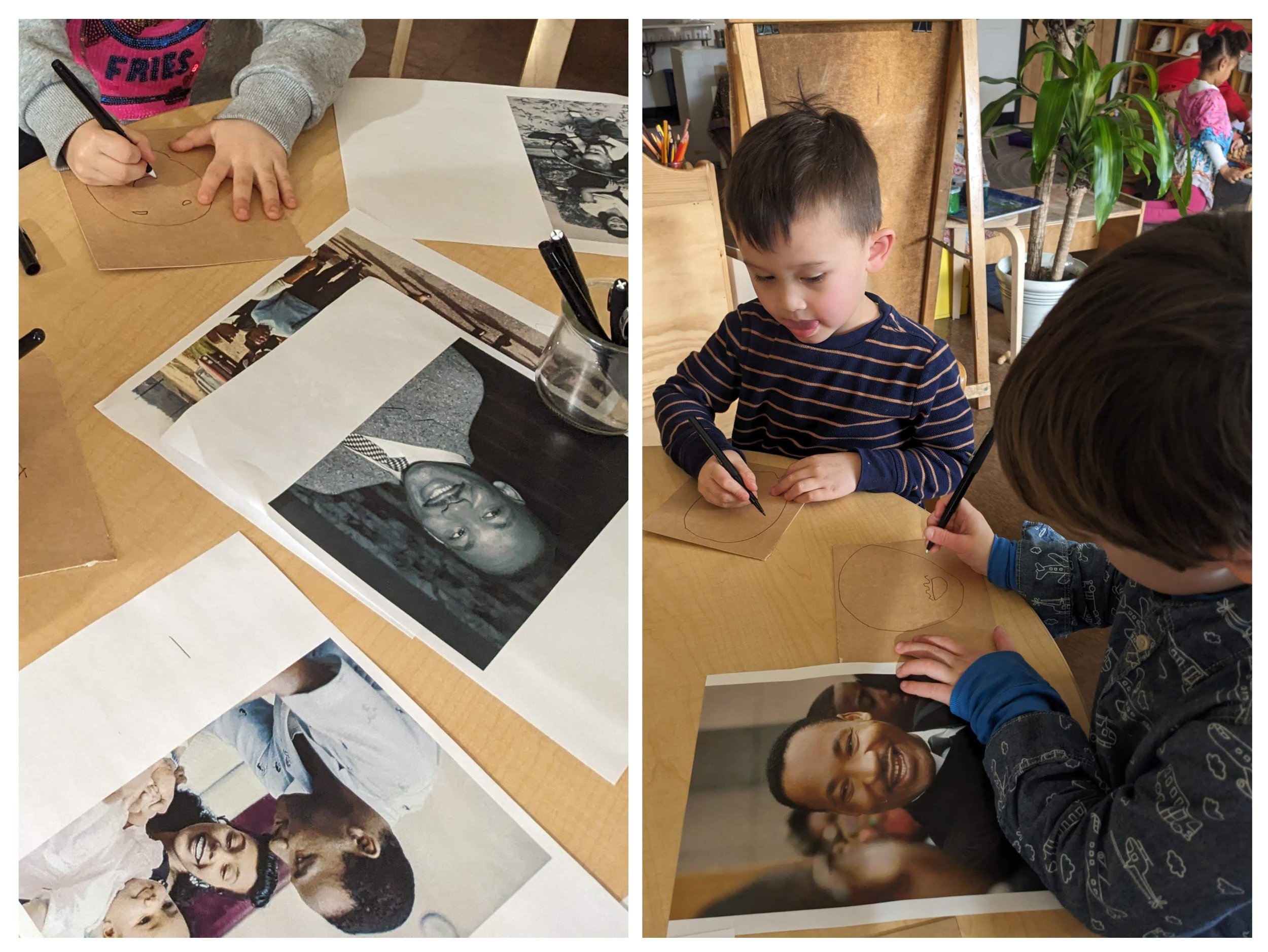
We divided the children into small groups, and invited them to look at some photographs of Dr. Martin Luther King Jr. The photographs included a picture of him during the march from Selma to Montgomery, two portraits, and images of Dr. King with his family.
None of the children recognized Dr. King by sight, and so we took the opportunity to notice and wonder together before even mentioning his name.
What do you notice about this person?
"I see a man"
"He looks kinda old."
"He doesn't have a lot of hair."
"It looks like he's happy."
"It looks like he's nice because he's smiling."
"I see a bow tie."
"He looks like he's laughing."
"I see facial hair."
What do you notice in these pictures? What is he doing? Who is he with?
"I see a baby and a mom."
"I see a baby standing up. That means he learned how to walk!"
"Aw, look he's smiling at the baby."
"He's holding a hula hoop so his baby can stand."
"He's walking with lots of people."
"So many people!"
"He's doing a protest."
"Maybe they are singing."
"Just like we were doing today!"
"He's protesting. He's doing something special and everybody hears when he says 'I have a dream' that he wants to happen to his kids."
These pictures are about a real guy who lived before you were born. His name is Dr. Martin Luther King, Jr.
Dr. Martin Luther King, Jr. had a family. He was a dad and had a wife named Coretta. He liked writing and singing and he helped a lot of people.
He wanted to make sure that everyone was treated fairly.
We are looking at real pictures of him and talking about him because he cared about fairness just like we do. He helped grown-ups work together to make fair rules.
Drawing can be a powerful way of seeing something, so we then invited the children to draw a picture, either based on one of the photographs, or from their own imagination.
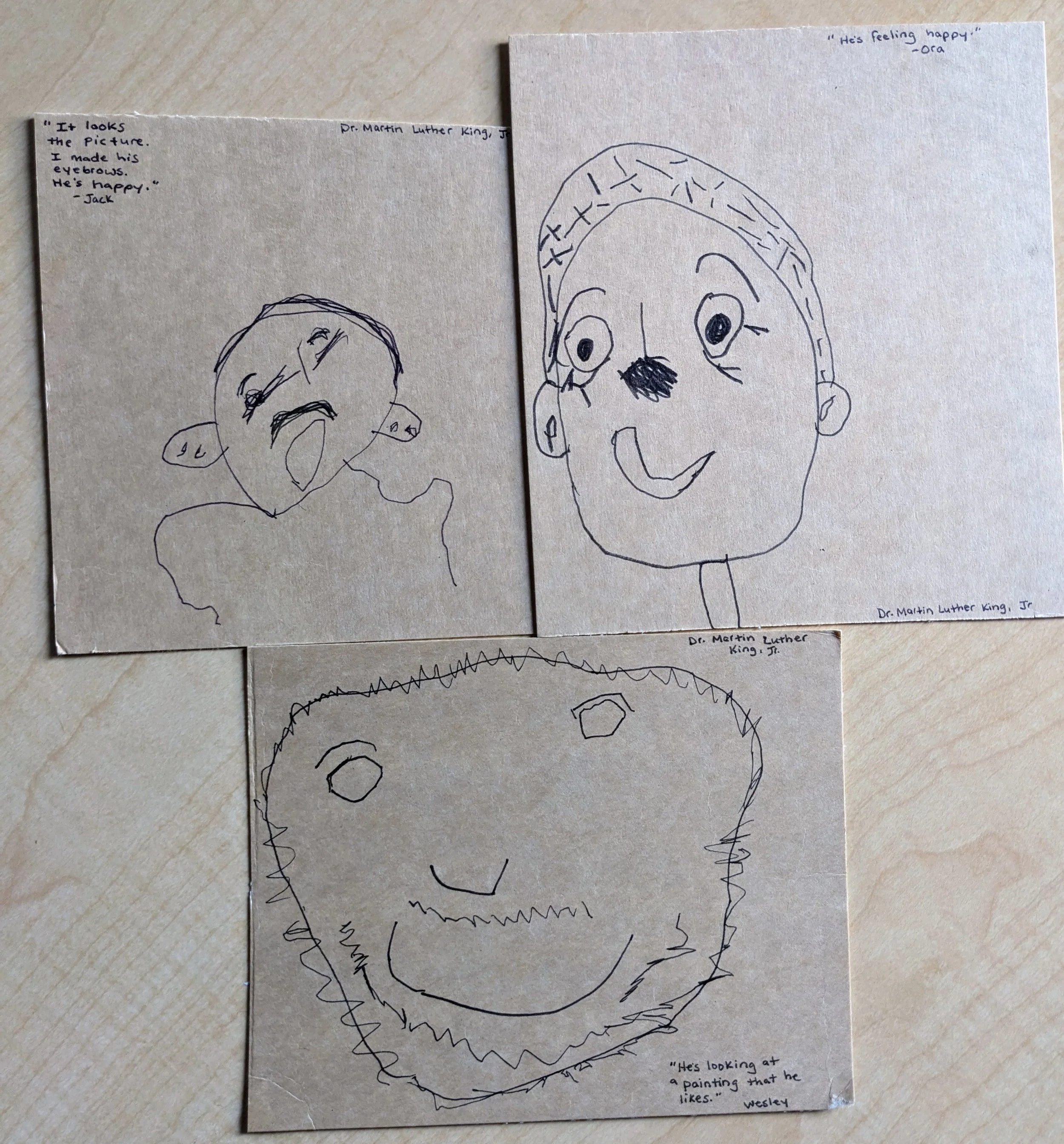
Many of the children's drawings include details such as Dr. King's mustache, his smile, and the laugh lines at the corners of his eyes.
Several children chose to draw him marching, or spending time with his family.
Children offered explanations of their drawings, including:
"He's happy because he's looking at a painting that he likes."
"This is Martin Luther King and all the people who loved him."
"He's angry about the world being the same everyday."
"He's walking so much, maybe 100 miles or more."

While mention of Dr. Kings' death did arise in each of the three groups, I modified the conversation depending on the children's questions and responses.
In one group, the children did not know anything about MLK's death. They asked how old he is when I mentioned that we celebrate his birthday as a holiday. I explained that "He died before most of your parents were born," and "If he were alive today he would have been almost 100 years old." None of the children asked how he died, and we continued talking about his fight for fairness.
In another group, a student asked, "He's the one who got a big boo-boo, right? I hope he didn't die." A classmate responded, "He did die." I said, "That is true. Someone hurt him and he died. But, he spent his whole life helping people and working really hard to fight against rules and ideas that were not fair." In this group, there were no follow-up questions regarding his death, so I did not offer more detail.
In one of the groups, the moment I started saying, "these are pictures of Dr. Martin Luther..." a student immediately jumped in, "Do you know how he died? He got shot by a gun." I offered the same response as the previous group.
The children in this group had many more questions and comments:
"Is this picture when he was at the hospital?"
"Why did he get shot by a gun?"
"He was doing a speech and he died."
"It was a real real gun."
"When my mom told me he got shot by a gun I was trying to not be scared of that."
In response, I offered some reassurance and more context:
Hearing about someone dying that way can definitely be scary. You might also feel sad or mad or confused. There were some people who were angry at Dr. King. They said, 'We like it when things aren't fair. We're happy that things aren't fair and we don't want to change’. Someone decided to hurt him to try and stop him from talking about and working for fairness. But guess what, all of the other people who did agree with Martin Luther King, they kept fighting for fairness. Even though he died a long time ago, we still celebrate his birthday every year to remember him and to help remind us how important it is to work to make things fair.
Those of us who teach here at the Center School have a unique opportunity to address social justice, even with the very youngest of learners in our community. Our shelves are filled with books that are banned in other educational settings. We are free to explore topics that teachers around the country are forbidden to discuss.
As we guide children through difficult aspects of history and the realities of our current world, we know that we will not always “get it right.” We will make mistakes, and our pedagogy and practice will continue to evolve and change. Still, we continue forward with a commitment to accuracy and a deep consideration for child development.