
Learning From the Land: See, Think, Wonder With The Pups (1st/2nd)
Some of our richest learning this past week happened at Basecamp, where the children noticed all sorts of extraordinary things: woolly bear caterpillars, salamanders tucked beneath logs, enormous slugs, mysterious purple flowers, shiny pink rocks, and very large acorns! We have been keeping a list inside the classroom of these interesting sightings and introduced a See, Think, Wonder protocol during stations to help deepen our observations and strengthen our scientific thinking. Rather than simply identifying something we find, we are practicing looking closely, describing what we actually notice, sharing our interpretations, and asking questions that might lead us toward new discoveries.
See: What do you notice? What details can you observe with your eyes and other senses?
Think: What do you think might be happening? What ideas or explanations can you imagine based on what you see?
Wonder: What questions does this discovery inspire? What would you like to investigate next?
These three simple prompts invite children to move from quick observations toward deeper inquiry. They help us distinguish between what we can directly observe and what we are beginning to hypothesize. They also remind us that not knowing an answer is not a problem; in fact, a good question can be the beginning of some wonderful learning!
Here is a little window into the Pups’ thinking this past week.
Woolly Bear Caterpillars: Looking Closely at a Tiny Creature
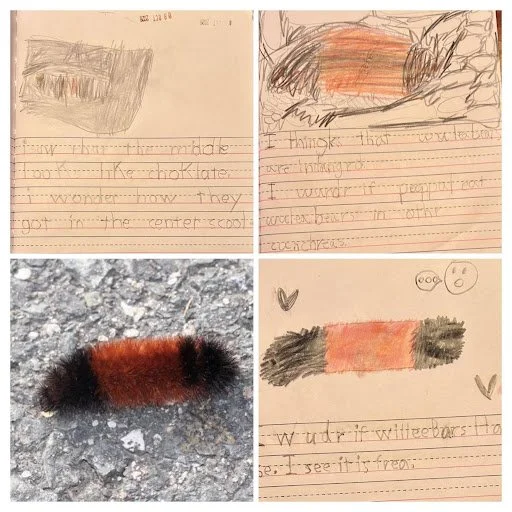
Lilac observed, “I saw that the middle looks like chocolate. I wonder how they got in the center school.”
Whitney wondered, “I wonder if woolly bears have eyes. I see it is furry”
Kestrel B. offered a hypothesis and a bigger-world question: “I think woolly bears are endangered. I wonder if people eat woolly bears in other countries.”
What a wonderful example of how one small creature can open so many doors! The children moved from noticing texture and color to wondering about anatomy, habitat, conservation, and human relationships with animals. Their questions give us plenty to investigate together. We can look closely at caterpillar anatomy, learn more about the woolly bear's life cycle, and explore which of our ideas can be answered through observation and which might require research.
Leaves, Sunlight, and the Big Questions of Science
As we explored the changing leaves, Chase offered this wonderfully ambitious theory:
“Leaves change in the fall because the chlorophyll leaves when the sun leaves, but the earth comes too slow, so the earth spins because of the sun, but what makes the sun spin?”
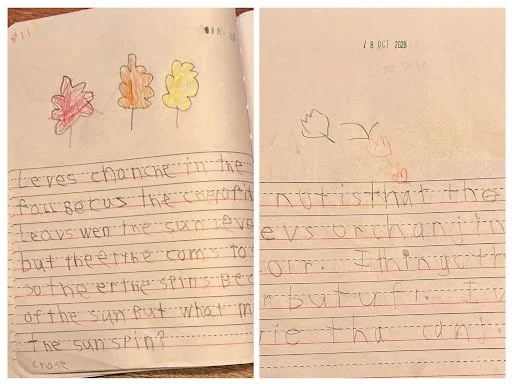
Chase is working to connect several big scientific ideas: chlorophyll, seasonal changes, Earth's rotation, and the movement of the sun across the sky. This is exactly the kind of interconnected thinking we hope to nurture. Their explanation gives us an opportunity to explore what causes leaves to change color while also honoring the bigger questions that emerge when children begin connecting ideas across the natural world.
Fran shared, “I noticed that the leaves are changing color, I think they are beautiful. I wonder why they change.”
Fran's observation holds both aesthetic appreciation and scientific curiosity. The beauty of the leaves is not separate from the science; it is often what invites us to look more closely in the first place.
More Basecamp Discoveries: Flowers, Slugs, Salamanders, and Shiny Stones
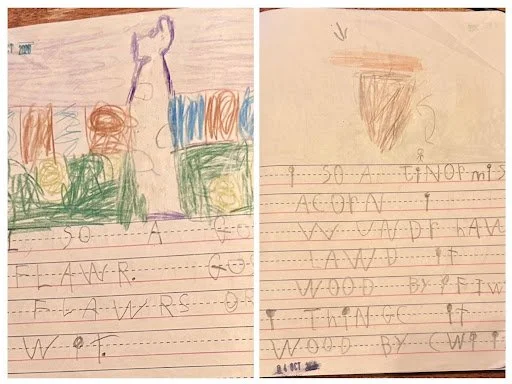
Kestrel Acadia said, “I saw a ginormous acorn; I wonder how loud it would be if I whistled in the cap. I think it would be quiet.”
This observation takes us from collecting a natural treasure to imagining an experiment. Some students love to turn the caps of acorns into whistles. What might happen if we tried it? Would the size or shape of the acorn cap affect the sound? How could we test our prediction?
Kestrel Acadia also noticed, “I saw a ghost flower; ghost flowers are white”
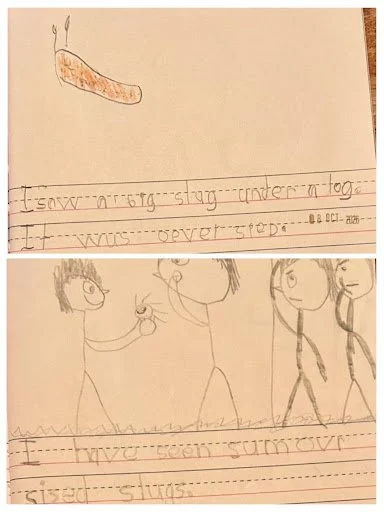
Sam reported, “I saw a big slug under a log. It was oversized.”
Fred added, “I have seen some oversized slugs.”
Sam also shared, “I saw a yellow spotted salamander. It was under a log.”
And Korra observed, “I saw a salamander. It was under a log.”
These discoveries remind us how much life can be found in places that might otherwise go unnoticed. Lifting our eyes to the trees is one way to learn about the forest, but looking beneath a log can reveal another whole world. We are practicing being careful observers and respectful visitors, taking time to notice the creatures who share our outdoor classroom and returning their little homes as gently as possible.
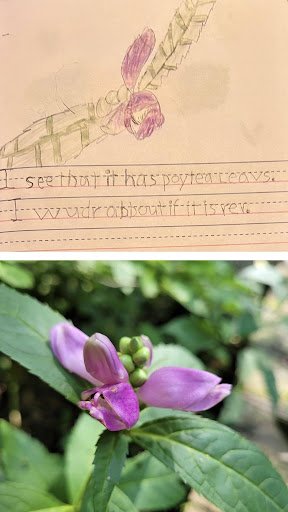
Whitney brought another question to our attention while looking at an interesting purple flower: “I see that it has pointy leaves. I wonder about if it is rare.”
This is a beautiful example of a child moving beyond identification toward questions about biodiversity and how common or unusual a plant might be. We can use careful observation, field guides, and further research to investigate what we find.
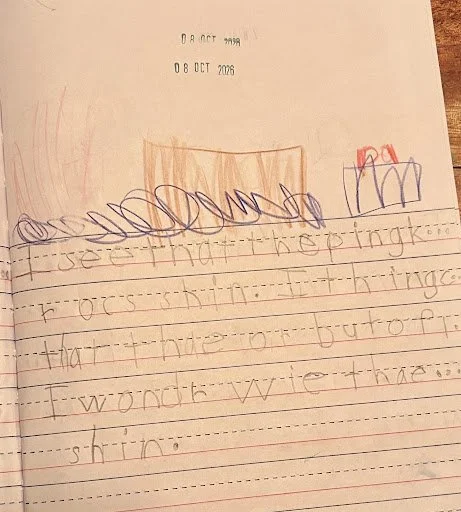
Finally, Fran noticed: “I see that the pink rocks shine. I think that they are beautiful. I wonder why they shine.”
Fran's question invites us to investigate the physical properties of rocks and minerals. What makes some surfaces sparkle? Is it the way light reflects off tiny mineral crystals? What might we discover if we look at the rocks from different angles or compare them with other stones?
Taken together, these observations show the Pups practicing some of the most important habits of scientific inquiry: looking carefully, describing details, developing theories, making predictions, listening to one another, and asking questions that lead to more questions. They are learning that the natural world is full of patterns to notice, mysteries to explore, and discoveries waiting to happen.
And perhaps most importantly, they are learning that their own observations and questions matter.
As we head into another autumn week, we are grateful for the many ways the Pups invite us to slow down, look again, and see the extraordinary in the seemingly ordinary. We hope they are bringing some of that curiosity home with them!