
From Associative to Collaborative: Co-Constructing Meaning in Power Primes Dramatic Play
In early childhood classrooms, play often shifts in form as children develop new social and cognitive capacities. Mildred Parten’s (1932) stages of play describe how children move through different ways of engaging with peers, including solitary, parallel, associative, and cooperative (collaborative) play. In associative play, children show strong social interest and interact frequently with peers, yet their play remains organized primarily around materials rather than shared ideas. Children may play beside one another, negotiate turns, or want the object a peer is using, but the interaction is not yet unified by a collective goal or storyline.
In the fall, much of the Power Primes’ play reflected this associative pattern. Children were highly social and engaged with one another, but the focus of interaction was often on possession of materials: who had the truck, who wanted the baby doll, whose turn it was. Language centered on negotiating objects- “mine,” “my turn,” “can I have that?” -more than on constructing a shared narrative.
Understanding these stages of play informed both the classroom environment and the structure of the day. In the dramatic play area, materials were pared down and made more open-ended. Play food was replaced with colorful wooden blocks, scarves, silks, and loose parts. These materials invite symbolic transformation rather than fixed use. At the same time, the class began breaking into two small groups during indoor play periods. In these smaller configurations, children have more space for their ideas to be heard, and quieter children have greater access to group play.
Since returning from break, there has been a noticeable shift in how children interact during these small-group play periods. During a recent group play session, the children became deeply involved in a complex “Christmas” dramatic play narrative. What stood out was the way children were communicating, coordinating, and building meaning together. The documentation that follows includes excerpts of dialogue from this episode that illustrate this shift.
The play begins when Owen finds a lambskin beard and puts it on.
Owen: “We are elves. You are elves and I am Santa. I have a beard so I am Santa.”
Immediately, the group organizes around this idea. Roles are not assigned by an adult but are taken up and reinforced by peers.
Shevy: “Only if you’re sleeping… here’s your stocking if you’re sleeping.”
(She drops a bag of blocks next to Jack, who is lying on the rug.)
Jack: “Oh… I only get popsicles?”
Owen: “Go to sleep!”
Harper: “I want a present!”
Mae: “It’s not ready yet!”
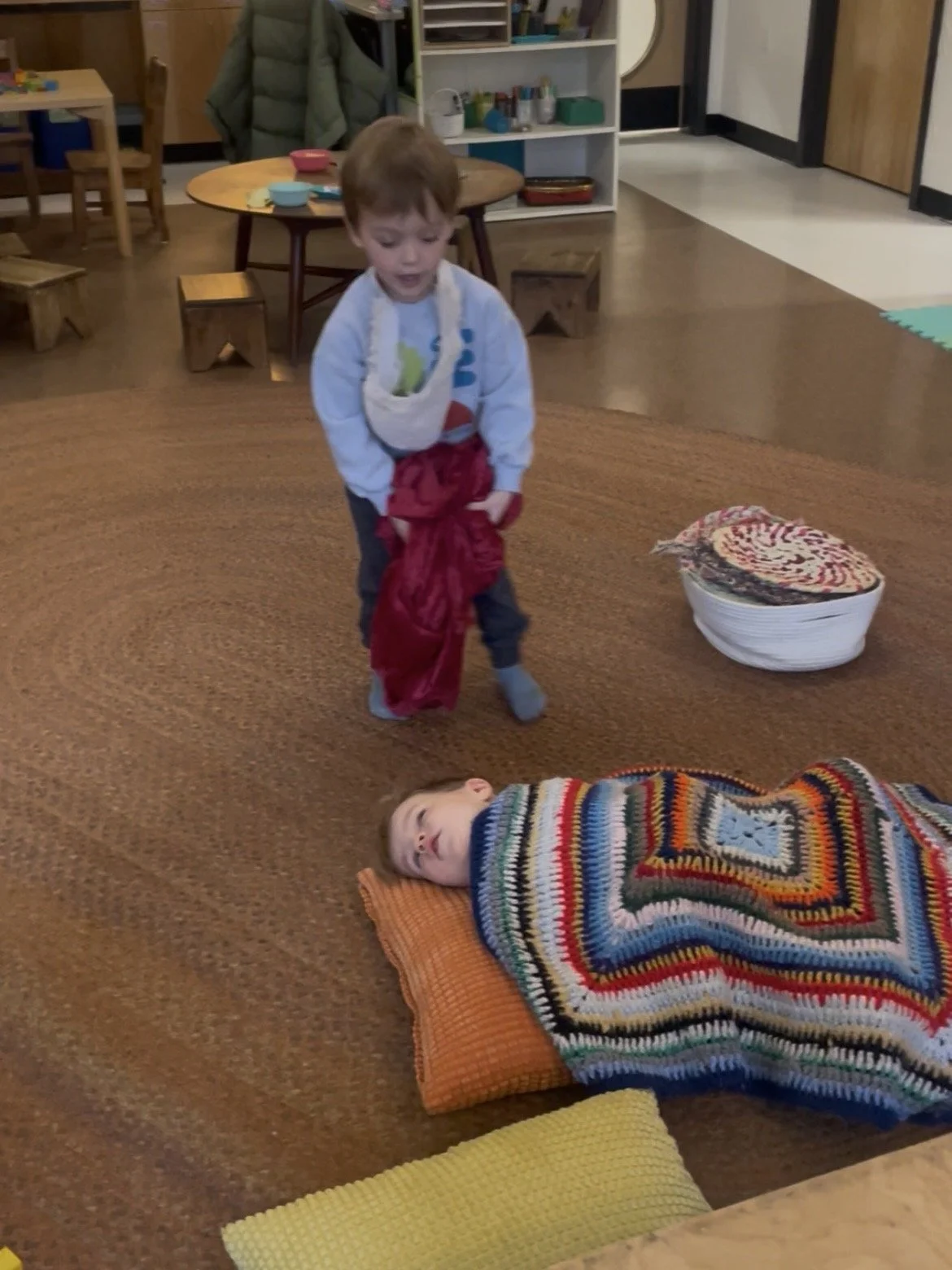
Owen (deep voice): “Ho ho ho. If you want presents then go to sleep!”
In these exchanges, the group establishes the rules of the story world. “Sleeping” becomes the condition for receiving gifts. Santa delivers. elves prepare. The logic of the game is shared and upheld through language.
Bode communicates his role clearly while expressing his desire to participate in the outcome of the story:
Bode: “I’m sleeping. I just want presents.”
Jack consistently reinforces Owen’s role:
Jack: “Santa, keep it behind the climber, okay Santa?”
Shevy guides others’ engagement with the materials:
Shevy: “Open it! You get to see.”
The children are coordinating identities, expectations, and responsibilities within the group. Roles are stabilized through repetition and peer acknowledgment.
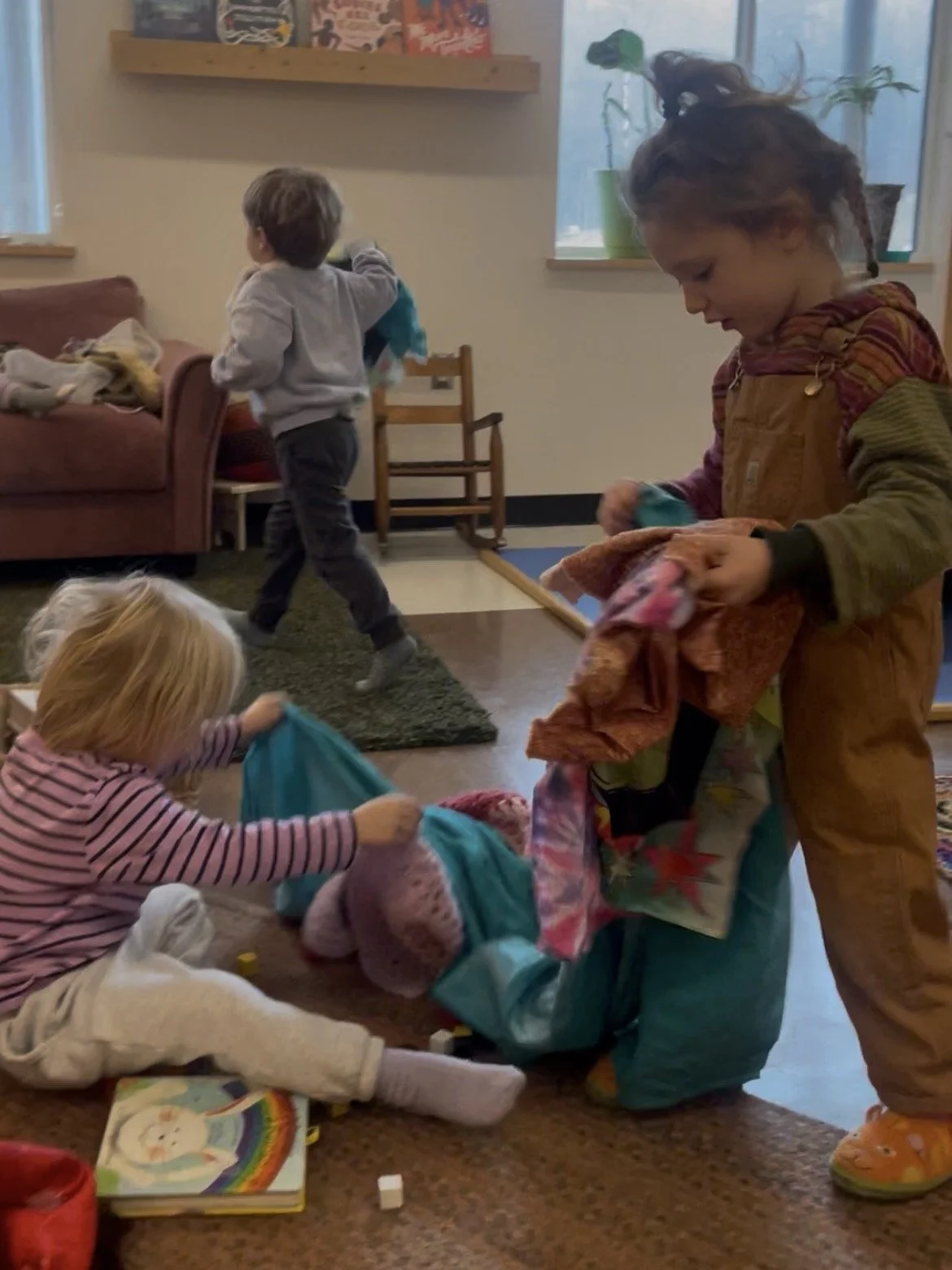
The symbolic meaning of materials is also collectively constructed. A blanket becomes wrapping paper, and blocks and scarves become presents. Owen models how wrapping should work:
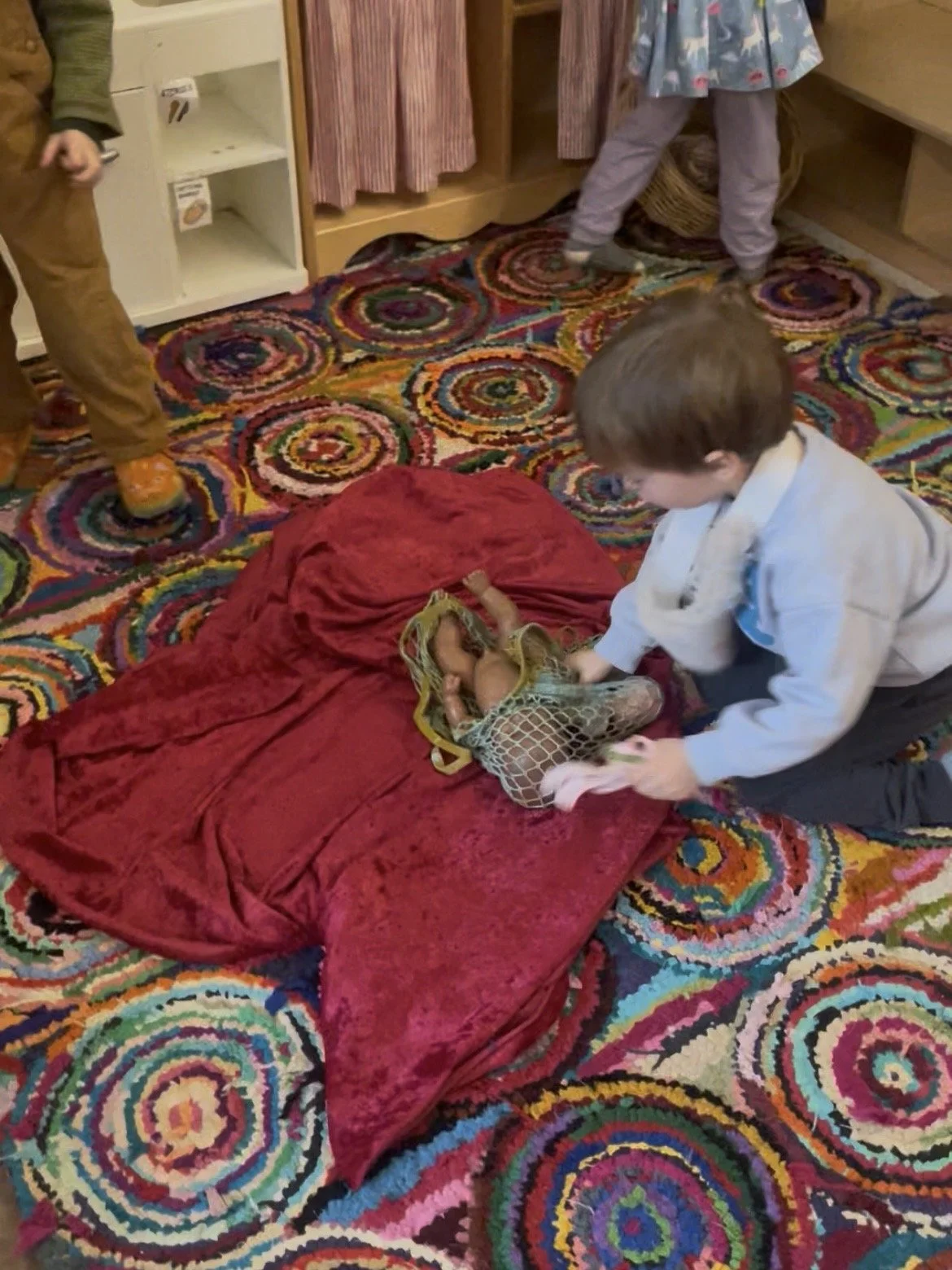
Owen: “You fold it like this… and wrap it like this… and put it near the sleeping kids.”
Other children adopt this method. The group now shares not only the story but the procedures for how the story unfolds.
At the same time, children participate in different ways within the same narrative. Some are actively preparing and delivering gifts. Others remain on the rug as recipients. Harper, lying under a blanket, removes blocks from her stocking and begins arranging them carefully. She is playing independently with the materials while staying within the shared story. Other children read books on the rug or rest under blankets while the “elves” work. This coexistence of independent material engagement and collective narrative illustrates a transitional zone between associative and collaborative play. Children are still enacting familiar play schemas- wrapping, transporting, stacking- yet these actions are now embedded within a shared meaning system.
Spatial decisions are negotiated together:
Jack: “How about behind the climber?”
Owen: “Oh yeah, good idea. So nobody sees the presents.”
The couch becomes Santa’s sled:
Mae: “We need Santa’s sled.”
Jack: “There it is!”
Owen: “No, that is not it because it is closed. But I know where Santa’s sled is.
Presents are carried, piled, wrapped, and delivered with sustained attention to the shared goal. Individual actions make sense because they contribute to the collective narrative.
Throughout this play, I noticed how the children are beginning to coordinate ideas rather than only materials. They are still engaged with objects in ways characteristic of associative or parallel play, but those actions are now organized by a shared storyline, negotiated roles, and group agreement about symbolic meaning. Children communicate participation not only through possession of materials but through language that signals identity, intention, and alignment with the group.
In this small-group context, play becomes a site of co-constructed thinking. Children use dramatic play to explore roles, sustain shared ideas, and negotiate meaning with one another. The shift from focusing primarily on objects to focusing on collective narratives reflects developing social, cognitive, and communicative capacities. Through play, children are learning how to think together.