Getting To Know Adventure Primes
At the beginning of the school year, a primary goal in many classrooms is for community members to begin to get to know each other.
Older children might respond to prompts like, "tell me about yourself," or "what do you think is important for everyone to know about you?" They might engage in art projects designed to highlight various aspects of their identity.
But what about very young children? How do 4-6 year olds get to know each other? How do teachers get to know the children in our care? What activities and experience should we prioritize if we want children to know each other, and if we are hoping to gain insight into children's development and evolving identities?
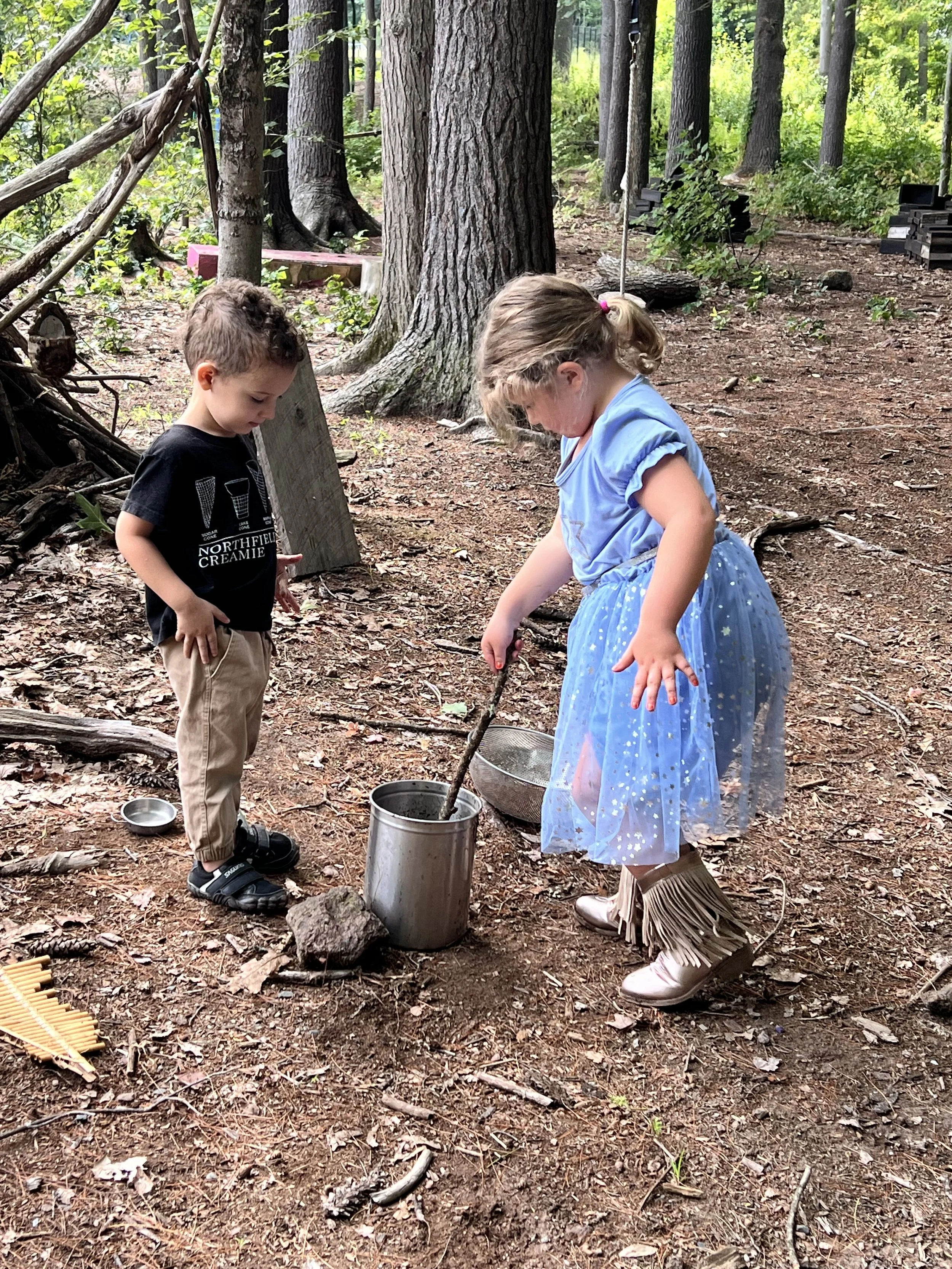
The answer, of course, is play.
Children get to know each other by playing together-- especially when they engage in collaborative, imaginative play.
Vivian Paley, a teacher-researcher and MacArthur Genius Grant recipient, wrote extensively about the powerful impact that storytelling and fantasy play has on children's social-emotional and academic growth. She describes fantasy play as, "the main repository for secret messages, the intuitive language with which children express their imagery and logic, their pleasure and curiosity, their ominous feelings and fears." Children reveal themselves intimately through their play, and when they play together children quickly begin gathering important information about their peers.
After only eight days in school together the Adventure Primes may not know the names of all of their classmates, but many could already tell you:
Who likes to be a demon when kids are playing KPop Demon Hunters
Who will help you build a zoo in the block area
Who will always be a dog or a cat in the game
Who knows the best way to make "cinnamon powder" in the mud kitchen
Who can help you organize a performance
Who to ask if you want to play family and who will probably say yes to a chasing game
Who is always up for a game of Snail Pace Race or Hoot Owl Hoot
Evolutionary science tells us that humans are naturally hard-wired to learn through play. For young children, play is literally the engine that drives their development. Observing, documenting, and reflecting on children's play is how teachers learn about the children's interests.and how we gain insight into where they are in their social-emotional, physical, and cognitive development. Proviging long, uninterrupted periods for free play means that, after only a week and a half of school, we can already tell you:
Who is experimenting with power in their relationships
Which shared interests are bringing children together
Who can stay regulated during a disagreement
Which play skills will need some explicit instruction
Who is drawn to large group play and who prefers playing alone or with only one other peer
Where literacy and math are showing up naturally in children's play
Where we need to provide more structure and scaffolding to support individual children in their play
All of this information is incredibly valuable as we plan for the weeks and months ahead as it will inform our decisions about which materials, experiences, and discussions to prioritize during this first part of the school year.
There is so much power in the children's play, and so much for us to learn! We are so fortunate to teach at a school where play is honored and recognized and valued as essential for children's learning.